

NAAC-Accredited 'A++' - Grade 2(f) & 12(B) status (UGC) |ISO
9001:2015 Certified | FIST Funded (DST) SIRO(DSIR)

Research / Funded Projects
| TITLE | AGENCY | AMOUNT in Rs. | RESPONSIBILITY | STATUS |
|---|---|---|---|---|
| Smart D-bin for Sona Campus | Student SEED Money Scheme | 31,000 | Guide | Completed |
| Development of an Automated Tapioca Harvesting Machine | Student SEED Money Scheme | 48,000 | Guide | Completed |
| Convenient Gas Stoves with Built in Cylinder | Student SEED Money Scheme | 39,000 | Guide | Completed |
| Automatic Wall Painting Rover | TNSCST- SPS | 7,500 | Guide | Completed |
| Development of an Automated Tapioca Harvesting Machine | TNSCST- SPS | 7,500 | Guide | Completed |
| AICTE IDEA LAB | AICTE | 90,00,000 | Coordinator | Ongoing |
| Wall Painting Robot | Student SEED Money Scheme | 49,000 | Guide | Ongoing |
| Design and Development of an Automated Tapioca Harvesting Machine | MSME | 14,00,000 | Mentor | Ongoing |
1. Project Title: Smart D-bin for Sona Campus
Project Ref. No: SCT/SMS-S/22-23/MIP2
2. Student (Name, Year & Department):
- 1. Gokul S U / Final Year / Mechatronics Engineering
- 2. Shiva S P / Final Year / Mechatronics Engineering
- 3. Gokul S / Second Year / Mechatronics Engineering
- 4. Mohan Raj J / Second Year / Mechatronics Engineering
3. Guide (Name, Designation & Department):
Dr. M. N. Vimal Kumar, Associate Professor, Department of Mechatronics Engineering
4. Project OUTCOME in terms of Technology Transfer:
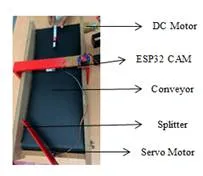
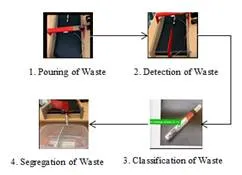
The machine learning–based smart waste segregation system offers an automated and efficient solution for modern waste management. Unlike traditional sensor-based methods, this approach uses image classification to improve sorting accuracy. A Convolutional Neural Network (CNN) model forms the core of the system, classifying waste into biodegradable (“bio”) and non-biodegradable (“non-bio”) categories using visual features such as color, texture, and shape.
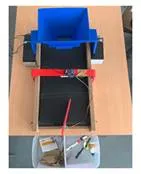
As shown in Fig. 1, an ESP32-CAM module captures real-time images of waste items and sends them to the machine learning unit for preprocessing and classification. The CNN analyzes the images and produces instant predictions. Based on this output, a servo motor directs the waste into the appropriate bin, enabling automated physical segregation.
A feedback loop is incorporated to record misclassifications and retrain the model, ensuring continuous improvement. The CNN, designed with three convolutional layers, was trained on 6,200 images and achieved 93.6% accuracy, demonstrating reliable performance for real-time smart waste segregation applications.
5. List of Patents Filed/granted (including inventors, title of patent & reference number):
- Inventors: 1. Dr.M.N.Vimal Kumar, 2. Dr.P.Suresh, 3. Dr.J.Thiyagarajan, 4. Mohanraj J, 5. Gokul S, 6. Jayandar B S, 7. Lokesh K, 8. Chaitanya V, 9. Kaviya T
- Title of Patent: A Smart System For Automatiing The Process of Waste Segregation
- Application No: 202441041120 | Filed Date: 27.05.2024 | Publication Date: 07.06.2024
6. Date of Start of Project: 20/02/2023 | Total Sanctioned Cost: Rs.31,000 | Sanction Date: 08/12/2022
7. Date of Completion: 27/04/2024 | Total Expenditure Made: Rs.12,485
1. Project Title: Development of an Automated Tapioca Harvesting Machine
Project Ref. No: SCT/SMS-S/23-24/MIP2
2. Student (Name, Year & Department):
- 1. Gokul S / Final Year / Mechatronics Engineering
- 2. Jayandar B S/ Final Year / Mechatronics Engineering
- 3. Mohan Raj J/ Final Year / Mechatronics Engineering
3. Guide (Name, Designation & Department):
Dr. M. N. Vimal Kumar, Associate Professor, Department of Mechatronics Engineering
4. Project OUTCOME in terms of Technology Transfer:
In Figure 1, the development of the automated tapioca harvesting machine represents a breakthrough in agricultural technology, offering a more efficient and cost-effective alternative to traditional manual harvesting methods. By integrating advanced mechanical components such as a roller chain saw, conveyor system, and hopper, this machine streamlines the entire harvesting process, significantly improving efficiency and productivity.
One of the key advantages of this system is its ability to cut and collect tapioca roots with minimal labor intervention. The automated cutting mechanism ensures precise and consistent slicing of the soil and roots, reducing damage to the crop while maintaining high-quality yields. The conveyor system then facilitates smooth transportation of the harvested roots to the collection hopper, eliminating the need for manual handling and accelerating the overall process. As a result, the machine not only reduces labor costs but also enhances the speed and effectiveness of tapioca harvesting operations.
5. List of Conference Publications from this Project:
Dr.M.N.Vimal Kumar, Gokul S, ,Jayandar B S, Mohanraj J and Lokesh K, “Design and Development of Tapioca Harvesting Machine", 2024 International Conference on Integration of Emerging Technologies for the Digital World (ICIETDW), Chennai, India, 2024, pp. 1-6, doi:10.1109/ICIETDW61607.2024.10941241. (Scopus indexed)


6. List of Patents Filed/granted (including inventors, title of patent & reference number):
- Inventors: 1. Dr.M.N.Vimal Kumar 2. Dr.P.Suresh 3. Dr. J. Thiyagarajan 4. Mohanraj J 5. Gokul S 6. Jayandar B S
- Title of Patent: Automated Tapioca Harvesting Machine
- Application No: 202341014927 | Filed Date: 6.03.2023 | Publication Date: 13.09.2023
7. Date of Start of Project: 22/03/2024 | Total Sanctioned Cost: Rs.48,000 | Sanctioned Date: 22/03/2024
8. Date of Completion: 27/04/2025 | Total Expenditure Made: Rs.28,371
1. Project Title: Convenient Gas Stoves with Built-in Cylinder
Project Ref. No: SCT/SMS-S/23-24/MIP1
2. Student (Name, Year & Department):
- 1. Darshanik T D / Nihal Ahamed R / Rajesh Kumar J P / Santhosh R U (II Year)
3. Guide (Name, Designation & Department):
Dr. M. N. Vimal Kumar, Associate Professor, Department of Mechatronics Engineering
4. Project OUTCOME in terms of Technology Transfer:
The Smart Hybrid Stove with IoT-enabled Gas Monitoring and Safety Control System is an advanced kitchen solution that integrates dual-mode cooking (LPG and induction) with intelligent safety and monitoring features. It allows users to switch between LPG and electric induction based on availability. A load cell sensor tracks cylinder weight to estimate remaining gas and usage duration. An MQ6 gas sensor detects leaks and triggers an automatic solenoid valve shutoff while sending real-time alerts via IoT connectivity (Wi-Fi/GSM).
When the user powers on the stove and selects Gas Mode, the system immediately displays the LPG status, indicating 40% gas remaining with an estimated 6 days of usage left. During operation, the MQ6 gas sensor continuously monitors for leaks. After a few minutes, it detects gas leakage caused by a loose regulator. Instantly, the safety system activates the solenoid valve automatically shuts off the gas supply to prevent hazards. Simultaneously, a buzzer sounds to alert the user, and a real-time notification is sent to the connected mobile phone via the IoT module.
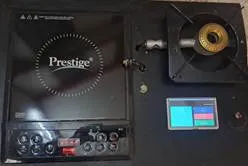
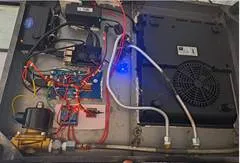
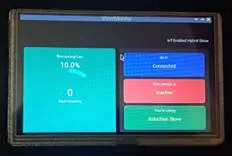
Figure 1. Prototype of Smart Hybrid Stove with IoT Safety System
5. List of Patents Filed/granted (including inventors, title of patent & reference number):
- Inventors: 1. Dr.M.N.Vimal Kumar 2. Dr.P.Suresh 3. Darshanik T D 4. Nihal Ahamed R 5. Rajesh Kumar J P 6. Santhosh R U
- Title of Patent: Smart Hybrid Stove With Integrated Gas Monitoring, Induction Control, and IOT Safety Management
- Application No: 202541116847 | Filed Date: 25.11.2025 | Publication Date: 25.12.2025
6. Date of Start of Project: 22/03/2024 | Total Sanctioned Cost: Rs.39,000
7. Date of Completion: 20/11/2025 | Total Expenditure Made: Rs.38,545
1. Project Title: Automatic wall painting rover
Project Ref. No: EME-0996
2. Student (Name, Year & Department): 1. Hemavijayraja.R.N 2. Sudharshan P 3. Barath M (Final Year)
3. Guide (Name, Designation & Department):
Dr. M. N. Vimal Kumar, Associate Professor, Department of Mechatronics Engineering
4. Project OUTCOME in terms of Technology Transfer:
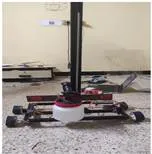
The automatic wall painting rover presented in this article has emerged as a transformative tool in both industrial and artistic applications, streamlining and enhancing the painting process with unprecedented efficiency and precision. By integrating sensors and computer vision systems, the robot navigates surfaces with remarkable accuracy, adapting seamlessly to irregularities and contours. The system's ability to provide precise and efficient painting solutions demonstrates its potential impact on various sectors. While the feasibility and benefits of using distributed robotic frameworks for interior painting are recognized, extensive testing is required to develop a fully autonomous robot for such applications.
5. Date of Start of Project: 20/01/2024 | Total Sanctioned Cost: Rs.7,500 | Sanctioned Date: 06/09/2024
6. Date of Completion: 21/10/2024 | Total Expenditure Made: Rs.7,500
1. Project Title: Development of an automated tapioca harvesting machine (EME-664)
Project Ref. No: EME-664
2. Student (Name, Year & Department): 1. Gokul S 2. Jayandar B S 3. Mohan Raj J 4. Lokesh K (Final Year)
3. Guide (Name, Designation & Department):
Dr. M. N. Vimal Kumar, Associate Professor, Department of Mechatronics Engineering
7. Project OUTCOME in terms of Technology Transfer:
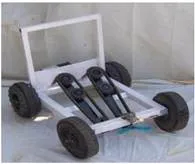
A automated tapioca harvesting machine is a compact, user-friendly machine developed to simplify and accelerate the harvesting of tapioca and similar crops. Built on a sturdy wheeled frame, it ensures stability and easy movement across field conditions. The machine enables simultaneous stem removal and plucking in a single operation, improving efficiency. Its adjustable digging depth and customizable frame make it suitable for crops like cassava. Designed to minimize root breakage, it ensures high lifting efficiency and better yield quality. By reducing labor requirements, saving time, and lowering operational costs, the harvester enhances productivity, sustainability, and profitability for farmers cultivating tapioca and related crops.
8. Date of Start of Project: 03/01/2025 | Total Sanctioned Cost: Rs.7,500 | Sanctioned Date: 13/05/2025
9. Date of Completion: 12/05/2025 | Total Expenditure Made: Rs.7,500